news article
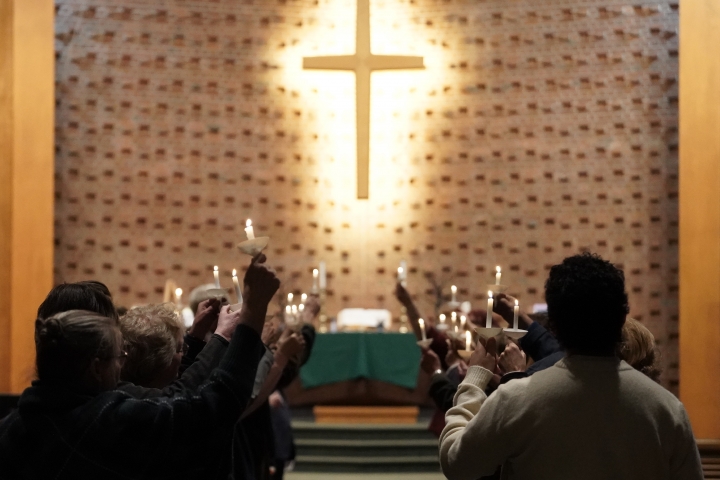
Faithful Resistance Across the Northeast: United Methodists mobilize in prayer, witness, and action for immigrant justice
March 2, 2026 / By NEJ Communicators / .(JavaScript must be enabled to view this email address)
As hundreds of United Methodists and partners gathered in Washington, D.C., for Faithful Resistance: A Public Witness for Immigrant Justice, a powerful, parallel movement unfolded across the Northeastern Jurisdiction (NEJ). From New England to Upper New York, Western Pennsylvania, and the Baltimore-Washington & Peninsula-Delaware Area, congregations and communities joined in coordinated acts of prayer, worship, hospitality, and public witness demonstrating that faithful discipleship is both local and connectional.
Across state lines and conference boundaries, United Methodists embodied a shared conviction: faith is not passive. It is active, visible, and grounded in the call of Christ to love, welcome, and stand with the vulnerable.
A Movement Rooted in Faith, Not Partisanship
In the days leading up to the public witness, clergy and lay leaders from across the jurisdiction gathered via Zoom for training on peaceful protest and legislative engagement. A central question emerged: How does this work remain non-partisan?
Bishop Minerva Carcaño, Chair of the United Methodist Immigration Task Force, offered a response that reframed the conversation. Immigration policy, she noted, has been shaped by leaders across political parties over time. “We are all responsible for where we are today,” she said, calling participants away from partisan divisions and toward shared moral responsibility.
Rather than aligning with political agendas, Bishop Carcaño emphasized that this movement is rooted in faithfulness. She pointed to the history of bipartisan efforts toward immigration reform, underscoring that meaningful change requires courage and collaboration across differences.
What began as a United Methodist initiative quickly expanded beyond denominational boundaries. Ecumenical and interfaith partners joined the witness, forming what she described as “the beginning of a new movement, an ecumenical interfaith justice movement.”
New England Conference: A Connectional Witness of Prayer and Solidarity
 Across the New England Conference, congregations gathered in sanctuaries, fellowship halls, and community spaces to join in prayerful, connectional solidarity for immigrant neighbors. Though separated by geography, churches across Maine, Massachusetts, New Hampshire, Rhode Island, and Vermont participated in a coordinated witness, embodying the unity of the Church as one body, one Spirit, and one call to love boldly.
Maine: At Brunswick United Methodist Church, participants gathered from 10 a.m. to noon for focused prayer, reflection, and communal discernment. The gathering provided space to lament, intercede, and recommit to the work of justice.
Massachusetts: Multiple congregations joined in solidarity, including Aldersgate UMC in Chelmsford, First UMC in Pittsfield, Blackstone Valley UMC in Whitinsville, Living Faith UMC in Beverly, and Westport UMC in Westport. These communities hosted prayer services and gatherings that lifted up immigrant families and explored ways to respond through advocacy and accompaniment.
New Hampshire: Wesley UMC in Concord gathered its community in prayer and reflection, affirming the call to stand with the marginalized and to engage in faithful witness within their local context.
Rhode Island: Arnold Mills UMC in Cumberland created space for communal prayer and conversation, grounding the gathering in Scripture and a shared commitment to justice.
Vermont: St. Paul’s UMC in St. Albans joined the regional witness, demonstrating that even in smaller communities, the call to justice is both urgent and universal.
In each setting, participants were reminded that connectionalism is not merely a structure but a lived reality. Even at a distance from Washington, D.C., congregations experienced themselves as part of a larger movement praying, witnessing, and advocating together.
Many reflected on Psalm 146:9: “The Lord watches over the foreigner and sustains the fatherless and the widow.” For those gathered, this Scripture served as both comfort and commission, a reminder that God’s concern for the vulnerable must also be the Church’s.
Upper New York Conference: A Network of Witness Across Communities
In the Upper New York (UNY) Conference, what began as a single gathering quickly multiplied into a network of events across the region. Churches opened their doors and extended their witness into the public square.
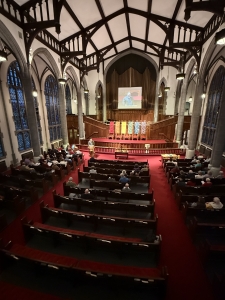 Gatherings were held at Centenary-Chenango UMC in Binghamton, St. Paul’s UMC in Ithaca, Victor UMC near Rochester, Auburn UMC, and University UMC in Syracuse. Together, these sites formed a web of solidarity spanning the conference. The Rev. Alan Kinney, Chair of the UNY Immigration Task Force and Social Holiness Team, articulated the theological grounding of the movement: “Our faith isn’t sedentary, it’s active. And if we’re not active in our faith, then it’s dying.” He emphasized that this work is not about politics, but about following Christ’s call to care for the immigrant, the poor, and the disenfranchised.
At Victor UMC, participants first gathered indoors to watch a livestream of the Washington event. Then, moving from observation to action, they stepped outside to line Main Street—holding signs, praying publicly, and offering a visible witness to their community.
“In the Kingdom of God we are all immigrants,” said Pastor Katrina Cappotelli, “naturalized not by paperwork and processes, but by mercy and grace.” The church’s lay leader, Dr. Maggie Graham, reflected on the church’s historical role in social justice, noting that standing for immigrant justice is not a one-day event, but an ongoing commitment.
Western Pennsylvania Conference: Worship as Prophetic Resistance
In the Western Pennsylvania Conference, the day’s witness was deeply rooted in worship, reflection, and communal action. The day began with prayer led by Bishop Sandra Steiner Ball and conference staff. Roger White, Conference Treasurer, offered a reflection drawn from the World Relief Prayer Guide, reminding participants that faithful resistance begins with a commitment to “do no harm,” especially to those who are most vulnerable.
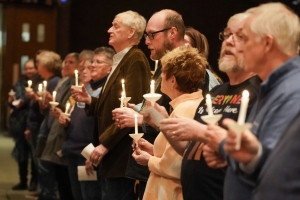 In the northern region, Asbury UMC hosted a livestream watch gathering, connecting participants to the national witness in Washington, D.C. Later in the day, Monroeville UMC became the focal point for a regional worship service organized by the Conference Connectional Witness Team.
The evening service wove together Scripture, testimony, prayer, and sacrament. Participants shared stories, reflected on the realities facing immigrant communities, and celebrated communion as a sign of unity.
The Rev. Dr. David Morse described the gathering as “a prophetic call to resist the present injustice visited on the immigrant community.” He noted that the experience challenged him personally to deepen his commitment to discipleship as described in Matthew 25.
The Rev. Alyce Weaver Dunn reflected on the spirit of the evening, describing how hope emerged through song, prayer, and shared stories. The service concluded with the lighting of candles and the singing of “They’ll Know We Are Christians by Our Love,” grounding advocacy in worship and reminding participants that love is the ultimate mark of Christian witness.
Baltimore-Washington & Peninsula-Delaware Area: Radical Hospitality in Action
While the streets of Washington, D.C., became a place of public witness, the Baltimore-Washington & Peninsula-Delaware Area embodied another essential expression of faith: radical hospitality.
In a gathering centered on immigration justice and welcoming the stranger, the act of welcome itself became a proclamation.
The Baltimore-Washington Conference partnered with the Northeastern Jurisdiction (NEJ) to ensure every participant was nourished. The NEJ Vision Table sponsored lunches for those traveling from within the jurisdiction, while the Baltimore-Washington Conference provided meals for those outside it.
_300_200.jpg) When attendance exceeded capacity at Capitol Hill United Methodist Church, nearby Ebenezer United Methodist Church opened its doors as the first overflow worship site.
When attendance exceeded capacity at Capitol Hill United Methodist Church, nearby Ebenezer United Methodist Church opened its doors as the first overflow worship site.
“We’re radically hospitable,” said The Rev. Bresean Jenkins, Ebenezer’s pastor. “We wanted to make sure that all of God’s children felt naturally and spiritually welcomed in the space before they went to show their voice in Faithful Resistance.”
Though Ebenezer has fewer than 100 members, its sanctuary seats 800. On that morning, buses began unloading participants seeking warmth from the cold. Laity welcomed nearly 200 people before worship even began, serving coffee, offering conversation, and opening doors.
“Small churches are still having an impact,” Jenkins said. “You don’t have to be large to be excellent.”
He emphasized that Ebenezer and Capitol Hill UMC serve in an ongoing partnership. “This wasn’t Capitol Hill versus Ebenezer. Pastor Stephanie and I always work together.” Clergy and lay leaders stepped seamlessly into service. “No one was looking for who was in charge. Everyone was being served in service.”
That same spirit of active faith echoed throughout the Area.
The Rev. Tina Blake, Peninsula-Delaware District Superintendent and Dean of the Cabinet, reflected, “It is the call of Jesus upon our lives to be the spokespersons for the less fortunate and the most vulnerable in our communities.”
The Rev. Evelyn Romero, Pastor of College Park UMC and Mount Memorial UMC, added, “It’s time for the Church to stand up… to advocate for others and to serve those who are being oppressed and marginalized.”
And the Rev. Carlos Reyes Rodríguez of Immigration Law & Justice Network named the urgency plainly: “Faith cannot be passive. It needs to be active. This is a matter of life and death.”
At Capitol Hill UMC, welcoming the stranger is not symbolic. Since 2022, the congregation has served more than 10,000 migrants, operating as a welcome center, running a Free Immigrant Tienda, and delivering weekly groceries to families facing heightened enforcement pressures.
In worship, in shared meals, and in open doors, the Church practiced what it proclaimed: to welcome the stranger is itself an act of justice.
Eastern Pennsylvania & Greater New Jersey
From the coastal shores of New Jersey to the banks of the Susquehanna River, leaders from across both conferences stood in solidarity with the most vulnerable among us. The Rev. Gina Yeske, Associate Superintendent, hosted a prayer vigil during the march. Forty people from across New Jersey prayed together as demonstrators made their way to Upper Senate Park.
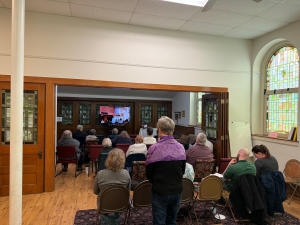 In Eastern Pennsylvania (EPA), thirty people gathered to livestream the service at Ross Street UMC in Lancaster, PA. The Rev. Jason Perkowski was grateful for the opportunity to gather with like-minded leaders. “It was wonderful to watch locally in community and to know that there are others who care about our neighbors, and to have conversations about how we can move things forward,” he shared.
In addition to the larger gatherings, others, like First UMC Somerville, hosted small watch parties in their church kitchens.
From D.C. to Lancaster to northern New Jersey, and in virtual spaces, United Methodists gathered to witness to the essential dignity of every human life.
Take Action
From New England’s prayer gatherings to Upper New York’s public witness, from Western Pennsylvania’s worship services to Washington’s radical hospitality, the message across the Northeastern Jurisdiction was clear: the Church is called to more than words. It is called to show up. To speak out. To stand alongside the vulnerable.
Grounded in Scripture and united in connectional ministry, United Methodists across the Northeast are embodying a faith that is both deeply spiritual and profoundly active.
As the movement continues, leaders are encouraging congregations and individuals to take further steps, engaging with elected officials, advocating for humane immigration policies, and continuing in prayer and public witness.
United Methodists affirm that faithful citizenship includes advocating for laws and systems that protect human dignity and promote justice for all. In this moment, the Church is remembering who it is and whose it is. Across the Northeast, that calling is being lived boldly in prayer, witness, and love.