news article
Do your part at Annual Conference to help make the world a little cleaner
May 4, 2026 / By Dr. Andrew Hartley, UNY Creation Justice Chair / .(JavaScript must be enabled to view this email address)
Do you remember 2020? Amidst the tragedy of the COVID-19 pandemic, we experienced a strange, silent miracle. The unending rivers of cars and trucks in our streets vanished. The 8:00 a.m. traffic jam dissolved into thin air. The world didn’t stop spinning; instead, the birds sang a little louder, and for the first time in decades, the horizon over our cities didn’t look like a smudged charcoal drawing. For the first time in decades, the Himalayas could be seen from India’s Punjab state. We realized, collectively and somewhat bashfully, that the world could function quite differently.
Yet, fast forward six years, and we are again juggling a perpetual rotation of global crises linked to the burning of coal, oil, and gas. Fossil fuel air pollution is responsible for nearly one in every five deaths. The high expenses (almost $12,000 per year) of owning a car are crushing American families, impacting the economically disadvantaged most severely.
According to a measure that includes more than body mass index, 70% of Americans are obese, partly due to lack of exercise. The effects of climate change, driven largely by fossil fuels, become more obvious by the year: collapsing infrastructure, spreading diseases, encroaching oceans, food supply failures, heat waves, and killer storms. Ostensibly to lower prices, governments subsidize fossil fuels by about $7 trillion annually (roughly $1,900 per person per year in the US). Due to our petroleum-driven transportation system, perhaps 45% of microplastics in the soils, air, and water are coming from vehicle tires. Worst of all, according to the Harvard Kennedy School, “Oil continues to fuel interstate conflict, with 25% to 50% of wars since 1973 connected to oil interests.”
Imagine the diseases, deaths, economic inequality, wasted resources, bodyweight problems, climate change harms, pollution, financial costs and wars we could avoid if we decreased our dependence on fossil fuels. For reasons like these, the UMC Social Principles urge the development and implementation of alternatives to burning fossil fuels, and Fossil Free UMC argues for full divestment from the stocks of associated companies.
The US would not be the first region to enjoy the benefits of reduced reliance on those fuels. Consider Puerto Rico. Before 2017, the territory’s electricity relied almost exclusively on an expensive, unreliable, fossil-fuel-driven grid that was subject to blackouts from storms. Then, after Hurricane Maria devastated the island, many households decided they had had enough and shifted to solar energy. Rooftop solar now accounts for a full fifth of all electricity generation there, a true success story for many homeowners in terms of prices and dependability.
Pakistan's recent energy revolution started similarly. Following the 2023 flooding that claimed the lives of 1,100 and left 33 million to deal with the consequences, a quarter of Pakistani households are now using solar panels. This now insulates millions of families from the energy supply crunch prompted by the US-Israel war on Iran.
What's the message here? Reliance on global supply chains for dirty energy—coal, oil, and gas—is dicey in a tumultuous world, but an energy crisis can be a good time to start a shift to clean, locally produced energy. This energy can be shielded from many of the hazards of centralized power generation, and effects of overseas wars that cut off supplies.
Earlier, the United States too faced the 1973 energy crisis, triggered by an oil embargo by the Organization of the Petroleum Exporting Countries. The US faced an unprecedented increase in energy prices and fuel shortages. In response, the president had 32 solar thermal panels installed on the White House roof to inspire and symbolize a shift toward renewable energy and independence. However, the next president removed the panels, believing government should have no part in shaping the future of the clean energy industry.
We have all heard the phrase, “To change the world, think globally, and act locally.” As many of us are preparing to travel to Syracuse for the 2026 Upper New York Annual Conference (AC) session, let us think about our transportation choices.
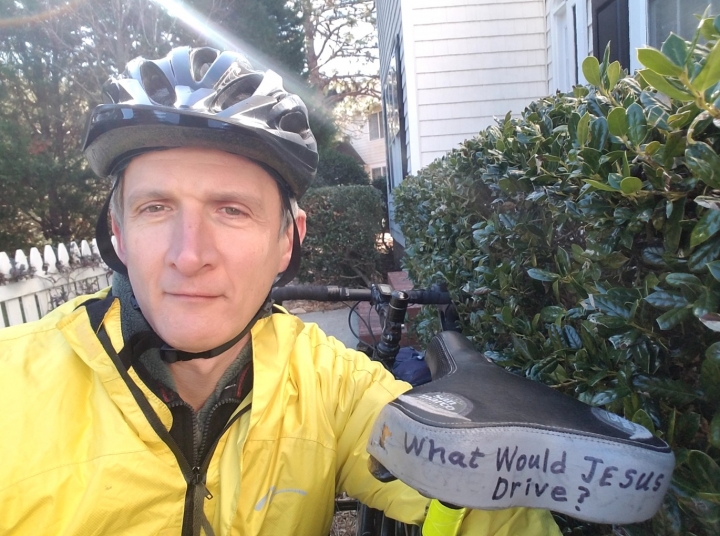
_225_300.jpg) For me personally, the vehicle I’ll rely on to travel from the Buffalo region is none other than a bicycle. While this mode of transportation may not be feasible for everyone due to physical limitations, God has enabled me to make the journey to the Syracuse area by bicycle the past two years—and, God willing, I’ll be doing it again.
For me personally, the vehicle I’ll rely on to travel from the Buffalo region is none other than a bicycle. While this mode of transportation may not be feasible for everyone due to physical limitations, God has enabled me to make the journey to the Syracuse area by bicycle the past two years—and, God willing, I’ll be doing it again.
Racks on the bike’s front and rear support packs called “panniers.” Extra strong wheels, a couple of spare spokes lashed to the frame and an air pump provide a hedge against mechanical problems. I could lighten my load somewhat by upgrading my 30-year-old camping gear to today’s featherweight fabrics, but for now it seems adequate. Time outside in God’s creation, pushing the pedals, and soaking up Upper New York’s rain, fresh air, and sunshine is food for body and soul, mine included.
Others might travel to AC via gasoline-powered cars. Additional transportation modes are available that depend less on fossil fuel, including electric vehicles, trains, and buses. Carpooling generally reduces fuel consumption relative to driving singly, while affording chances for fellowship. Like last year, complimentary shuttle service is available between most conference hotels and the Oncenter, obviating many conference participants’ needs for personal vehicles. Let’s follow the staff’s lead, not only by traveling thoughtfully to AC but by promoting bike-friendly and walkable streets and roads back in our communities.
Looking for additional ways to care for God’s creation during Annual Conference? The 2026 Upper New York Annual Conference Workbook highlights practical steps from the Creation Justice Team to guide your efforts during our time of holy conferencing.
Humanity has a long way to go to achieve full environmental responsibility. We are using up Earth’s resources about 400% too fast, “borrowing” the natural resources future generations will need. Let’s do what we can today, to keep the planet hospitable longer.
Additional references:
https://fivethirtyeight.com/features/why-puerto-ricos-electric-grid-stood-no-chance-against-maria/